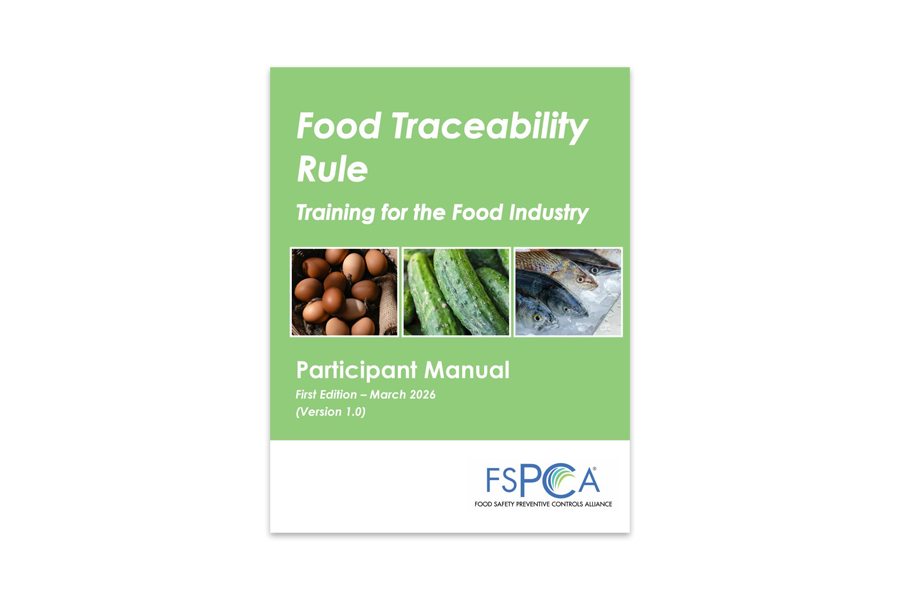
IFPTI Delivery: FSPCA Food Traceability Rule (FTR)- Training for the Food Industry Participant Course

$499.00

The FSPCA FTR Training for the Food Industry participant course is a core, industry-oriented training that provides participants with the knowledge that is needed to understand and comply with the U.S. Food and Drug Administration’s Final Rule on Requirements for Additional Traceability Records for Certain Foods, or Food Traceability Rule (FTR) under the Food Safety Modernization Act (FSMA).

The participant course content is focused on providing the participant with an understanding of FTR record keeping requirements, how to recognize the requirements applicable to them based on the supply chain activities they perform, how traceability data is transmitted through the supply chain, and what is required in a Traceability Plan. The training also covers how companies may approach establishing food traceability programs and procedures, including supply chain and data considerations.

To successfully complete the participant course, a participant must be present for the entire delivery and actively participate in the exercises. Otherwise, do not approve participant completion. An FSPCA assessment is not associated with the course at this time. If a Lead Instructor chooses to add additional requirements to their own delivery such as passing a test or demonstrating the ability to perform a task, a distinction must be made that the additional requirements are the Lead Instructor’s and not FSPCA’s.

COURSE WILL COVER:

  • Course introduction and objectives

  • Definitions, terms and key concepts

  • Application of the Rule

  • Traceability Plan requirements including farm mapping

    All deliveries cover the same exact curriculum in a minimum of 12 contact hours. 

The FSPCA FTR Training for the Food Industry participant course is a core, industry-oriented training that provides participants with the knowledge that is needed to understand and comply with the U.S. Food and Drug Administration’s Final Rule on Requirements for Additional Traceability Records for Certain Foods, or Food Traceability Rule (FTR) under the Food Safety Modernization Act (FSMA).

The participant course content is focused on providing the participant with an understanding of FTR record keeping requirements, how to recognize the requirements applicable to them based on the supply chain activities they perform, how traceability data is transmitted through the supply chain, and what is required in a Traceability Plan. The training also covers how companies may approach establishing food traceability programs and procedures, including supply chain and data considerations.

To successfully complete the participant course, a participant must be present for the entire delivery and actively participate in the exercises. Otherwise, do not approve participant completion. An FSPCA assessment is not associated with the course at this time. If a Lead Instructor chooses to add additional requirements to their own delivery such as passing a test or demonstrating the ability to perform a task, a distinction must be made that the additional requirements are the Lead Instructor’s and not FSPCA’s.

COURSE WILL COVER:

  • Course introduction and objectives

  • Definitions, terms and key concepts

  • Application of the Rule

  • Traceability Plan requirements including farm mapping

    All deliveries cover the same exact curriculum in a minimum of 12 contact hours. 

Meet Your Instructors

Lead Instructor: Carolina Schaffer

Carolina Schaffer is a recognized food safety expert and seasoned professional with over three decades of experience in the food industry, spanning both the private sector and state regulatory government. She is the owner of SMART Food Safety Solutions, LLC., providing expert training and consultancy. She also serves as an Assistant Program Manager for the Association of Food and Drug Officials (AFDO).

Lead Instructor: Cathy Martin

Cathy Martin is a food safety subject matter expert with over 39 years of regulatory experience in the public health sector at the state level. She has extensive experience with the Manufactured Food Regulatory Program Standards (MFRPS) and Food Protection Task Force (FPTF), supporting program development, assessment, and continuous improvement.